
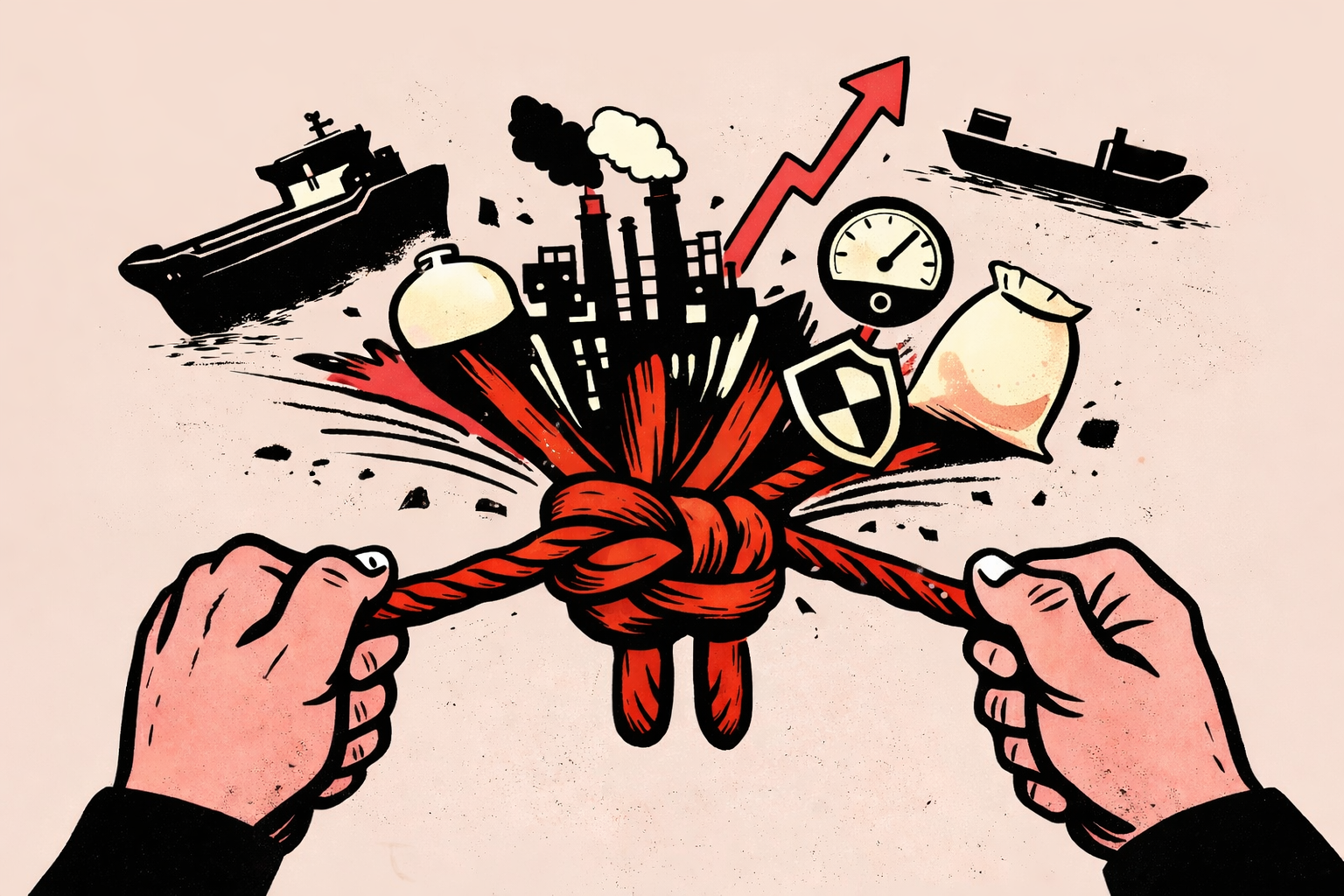
The disruption moving through the Strait is not confined to crude benchmarks. It is reshaping delivered energy costs, tanker economics, insurance availability, refinery behaviour and industrial procurement across a wider trade network.
The Hormuz crisis is no longer best understood as a simple spike in crude prices. It has become a corridor shock, one that is repricing the movement of energy and industrial cargo through a chain of interlocking mechanisms: physical disruption, freight scarcity, war-risk insurance, route dependence, refinery stress and downstream input costs. The benchmark barrel still matters. It is no longer the whole story.
What markets appear to be pricing is not only lost production, but impaired delivery. That distinction matters. A system can remain strained even when molecules still exist in aggregate, because the relevant question is whether they can be moved safely, insured economically and delivered on time. The problem is no longer confined to the upstream supply picture. It now sits in the logistics of moving energy through one of the world’s most concentrated trade corridors.
Hormuz matters because it is not merely a narrow waterway. It is a concentrated export corridor for multiple producers and multiple cargo classes. It carries large shares of seaborne crude, LPG, LNG, refined oil products and chemicals, including fertilizers. That concentration gives it an importance that exceeds its geography. At its narrowest point, the Strait is constrained not only by physical width, but by the much smaller navigable channels through which commercial traffic must pass. Its economic width is tighter than its map suggests.
That is why the crisis travels so quickly beyond oil. The Strait handles a material share of global seaborne energy trade, and LNG is central to that story, not peripheral to it. Crude has some substitution pathways and can draw on strategic stock support. LNG is often more constrained in the short run because replacement volumes and route alternatives are thinner. The market implication is straightforward: a disruption in Hormuz is not simply a question of what is produced, but of what can still be delivered reliably.
The result is a repricing of the delivered-cost stack rather than a move in one headline benchmark alone. Delivered energy cost is not simply Brent or Dubai. It is benchmark plus basis, freight, insurance, inventory time, waiting costs and operational friction. A chokepoint shock magnifies all of those at once. As war-risk premiums rise, as cover becomes harder to secure, as owners hesitate, as charterers book earlier to preserve schedules and as rerouting ties up tonnage, the cost to deliver energy rises even faster than the quoted barrel may suggest.
This is already visible in freight. Tanker markets began repricing even before the worst operational deterioration took hold. Rates rose as charterers accelerated bookings and risk appetite weakened. That widened into outright dislocation as shipping conditions worsened. What the market is now charging is no longer a modest geopolitical premium. It is a schedule premium, a security premium and a scarcity premium at the same time. Those are not marginal adjustments. They alter arbitrage, working capital and procurement behaviour across the trade chain.
Insurance is the second force multiplier. In ordinary market commentary, insurance often appears as a technical afterthought. In this crisis it has become one of the decisive commercial gates. A route does not need to be formally and permanently closed to become functionally impaired. If war-risk cover is withdrawn, restricted or repriced to levels that make voyages uneconomic or contractually difficult to finance, trade can slow sharply even without a legal blockade. This is why the crisis must be read in commercial terms as much as military ones.
That commercial logic helps explain why LNG may prove even more operationally constrained than crude in the immediate window. Delivered LNG cost in crisis conditions hinges on shipping time and vessel availability as much as on the nominal cost of liquefaction. Gas markets respond not only to supply loss, but to shipping stress. For the most exposed buyers, especially those with high import dependence, limited substitution options and power systems tied closely to gas, the issue is not only price. It is physical access under stressed logistics.
The significance of this is clearest in Asia. Much of the crude and LNG moving through Hormuz is directed there, which means the first and most acute sourcing distortions appear in Asian refining, power and industrial systems. Importers with high gas dependence face a sharper transmission from maritime insecurity into electricity costs, industrial output and input affordability. In such settings, the shock moves quickly from the energy complex into the broader real economy.
Crude markets themselves are sending a more nuanced signal than the headline price move implies. Prompt crude has surged and the curve has steepened into backwardation, indicating that scarcity is being priced most aggressively in the near term. Longer-dated pricing is more restrained. That suggests markets are not yet treating the crisis as a fully repriced permanent supply regime break. The current signal is more specific: an acute logistics shock severe enough to distort prompt markets, but not yet definitive enough to anchor a wholly new long-run supply order.
That distinction pushes attention downstream. Refined products may prove more economically binding than crude itself. Refining margins have widened sharply, while jet and gasoil cracks indicate tighter product conditions than crude benchmarks alone would reveal. This is where the phrase beyond oil becomes substantive. Strategic stock releases can help with barrels. They do not automatically solve refinery configuration issues, shipping bottlenecks, product imbalances or shortages of middle distillates that keep logistics and industry moving.
Diesel is especially important in that chain. It powers transport fleets, mining activity, heavy industry and large parts of the wider physical economy. The hardest economic pressure may therefore emerge not at the headline crude benchmark, but in the distillate layer beneath it. If the disruption is concentrated in distillate-rich crude and product flows, the effect travels quickly into freight, construction, industrial output and operating costs across sectors that are rarely discussed in the first days of an energy crisis.
The industrial transmission does not stop there. Refinery stress feeds into petrochemical inputs, plastics and packaging costs, and then extends into fertilizers. This is one of the least appreciated mechanisms in the entire episode. A chokepoint shock in Hormuz does not remain confined to tankers and terminals. It can move into food systems through fertilizer flows, and into manufacturing through higher feedstock and transport costs. That broadens the inflationary footprint well beyond what a crude chart alone would suggest.
Commercial behaviour then becomes its own transmission channel. Firms do not wait passively for official declarations of closure or reopening. They adjust procurement windows, build inventory buffers, lengthen scheduling assumptions and absorb higher working-capital demands. Those decisions are rational at the level of the individual firm. Collectively, they can worsen volatility. When freight and insurance turn unstable, supply chains can generate their own aftershocks through precautionary buying, storage pressure and later correction. In that sense, commercial hesitation is not just a response to disruption. It can deepen it.
This is also why bypass infrastructure deserves a restrained reading. Alternatives do exist, and some exporters have the ability to redirect part of their flows. But bypass capacity is limited, unevenly distributed and not designed to erase corridor risk altogether. More importantly, alternative nodes can become critical vulnerabilities in their own right under stress. A corridor shock does not disappear because part of the flow can be diverted. Pressure simply migrates to new bottlenecks, often at higher cost.
For procurement teams, traders and industrial planners, the strategic lesson is clear. The relevant risk architecture is not upstream production alone. It is network exposure. Firms need to think in terms of route dependence, insurance availability, freight optionality, refinery and product exposure, feedstock flexibility and working-capital resilience. In that framework, the question is not only whether oil flows resume, but whether the wider cost stack normalises quickly enough to restore commercial confidence.
That is the broader significance of Hormuz. The crisis is repricing global industry through three channels at once: commodity scarcity, logistics disruption and contractual finance. Each is serious individually. Together they create something larger: a network shock in which the ability to move energy safely, insurably and on schedule becomes as important as the existence of supply itself. That is why the story extends well beyond crude. What is being repriced is not only oil, but the architecture through which energy, freight and industrial inputs reach the real economy.